Imaginaries of Ambiance in Urban Climate Adaptation
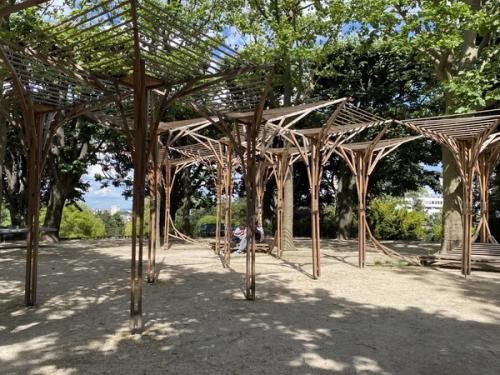
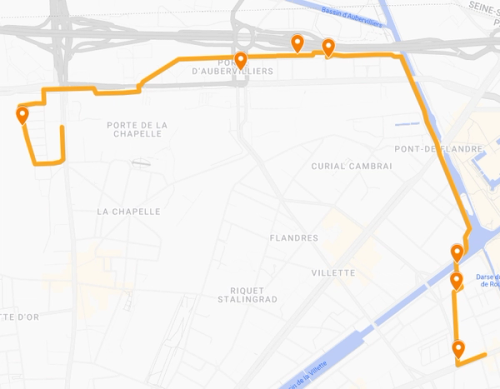
In the context of Paris’ recently introduced Plan Local d’Urbanisme bioclimatique, this article critically analyses the evolution of tree planting for urban climate adaptation through a focus on two urban forests: the Fôrét linêaire and the urban forest on the Parvis de l’Hôtel de Ville, planted in 2014 and 2024 respectively. Comparing their spatial forms through a distinction between initial openness and later enclosure, it argues that the latter is implemented in response to cultures of inhabitation — namely migrant encampment — that disturb official imaginaries of the ambiance of urban climate adaptation, as pursued through planning policies which frame tree planting as a means to pacify urban public spaces. Through ongoing engagement with these two urban forests in the form of a series of walks in the posture of both researcher and inhabitant, the article traces the response of normative publics and authorities to what are described as ‘counterpublic’ uses of the Fôrét linêaire, and asks how these may have shaped the later Hôtel de Ville project. Critiquing the policy of abandonment, it suggests the necessity of an ‘ethics of disturbance’ and a framework of ‘intimate ecology’ in the construction of broader imaginaries of cohabitation with the vegetal support structures of climate adaptation and their ambiances, protecting them against enclosure and further entrenchment of binary divisions in urban culture.
In the essay ‘A Sisterly Witch Dance in the Walled Garden’, curator and gardener Laurie Cluitmans confronts conflicting visions of the role of enclosure in the concept of the garden: that pocket of tamed vegetal life that is typically defined more by its separation from nature than its belonging to it. Both the words garden and paradise, as she recounts, have etymological roots in fencing off, walling in, and creating a retreat from the threatening wilderness beyond the pre-modern city. In this context, as Cluitmans argues, Derek Jarman’s refusal to enclose the garden he cultivated around his final home, Prospect Cottage in Dungeness, is a radical retort to the ‘conservative dogma about what a natural landscape should be’. ‘My garden’s boundaries are the horizon’, wrote Jarman in his diary on 1 January 1989, and in this blurring of boundaries is the seed of a queer ecology that resists sharp spatial and ontological distinctions in favour of ethics of disturbance and frottage. These ethics are a direct response to architectures and landscapes that, as trans performance artist and scholar Teo Ala-Ruona argues, act as machines for upholding separations between sensorial qualities (clean or dirty, healthy or sick) or binary categorical roles (male or female, intruders and insiders).
Like many European cities, Paris is turning to versions of the archetypal garden of domesticated nature as a strategy to combat both the causes and effects of climate breakdown. The City of Paris’ recently-implemented Plan Local d’Urbanisme bioclimatique (PLUb) lays out a vision in which a network of new spatial forms of ‘vegetalisation’ work as an infrastructural system for air filtration and cooling. Supporting this vision, the related Plan Arbre (Tree Plan) is a municipal policy document guiding the planting 170,000 new trees within the city limits between 2020 and 2026 — an increase of 85 per cent on top of the existing number of trees within the city limits. The flagship of this policy is the creation of multiple new ‘urban forests’ in key public spaces in the city: specific forms of planting whose implications this article explores below. Both documents frame trees as technologies able to help maintain a habitable climate in the face of summer heatwaves increasing in both severity and regularity, and to counter the disordering of hydrological patterns that leads to both increased flood risk and the drying out of soils.
Trees considered ‘as infrastructure’ — as urban technology startup Dark Matter Labs describe them in a paper selling the concept of data monitoring of the environmental and economic performance of trees — and enclosed in specialised zones in the model of the walled garden, become part of a technical substrate of urban life valued primarily for its ‘bioclimatic’ role. They are expected to maintain a healthy set of atmospheric conditions for the public realm through the reduction of heat and air pollution. However, the Tree Plan also refers explicitly to the roles of trees in managing what can be considered conditions of ambiance, particularly by absorbing noise pollution and therefore contributing to what the PLUb describes as the ‘pacification’ of the public realm. As we will see, there are tensions between ‘official imaginaries’ of trees as pacifiers of urban ambiance, and messier, more conflictual ways of experiencing and living within Paris’ urban forests. This article argues that these official imaginaries demonstrate a failure to cultivate what Nicola di Croce calls an ‘ethics of disturbance’: a welcoming of sensorial relationships that disrupt the centrality and dominance of the human.
As a result of this failure, the spatial form of urban forests in Paris has moved from openness and porosity that afforded ‘counter-public’ or ‘deviant’ (from a normative municipal perspective) modes of life, towards stricter enclosure that looks to limit the close contact between the human and non-human that Ama Josephine B. Johnstone describes as ‘frottage’ as part of her argument for an ethics of pleasure in ecological thinking. This article therefore proposes that ambient disturbance and the frottage of physical contact with the vegetal must be integrated into both official and popular imaginaries of urban climate adaptation to enable its spatial forms to be just and durable in the ways they integrate public life.